doPDF is a freeware PDF converter and we know users like it, based on the regular feedback we receive.
Since its first release it was downloaded more than 15 million times, with an average of 12-14.000 downloads daily (these are not unique downloads). With its popularity, we started getting more and more traffic from search engines too. Google in particular accounts for most of the search engine traffic, way ahead of Bing or Yahoo.
Starting in February 2011, Google initiated a major algorithmic change, called Panda. This is the single most important algorithmic change they did in the past few years, and is something that impacted a lot of websites. A short changelog of Google Panda releases/updates:
The new Panda updates have turned many SEO heads as we try to understand what the implications are for our sites and blogs. Google's purpose is to create a high-quality search experience for all searchers who tap in their search queries looking for the perfect content. Additionally, Google wants to deliver this experience quickly and efficiently and award high-quality sites. To quote Google directly:
"This update is designed to reduce rankings for low-quality sites - sites which are low-value add for users, copy content from other websites or sites that are just not very useful. At the same time, it will provide better rankings for high-quality sites - sites with original content and information such as research, in-depth reports, thoughtful analysis and so on."
All indications are that Panda is here to stay since Google is constantly looking to improve its searcher experience. We need to look beyond the quick fix and understand the long-term implications.
This new machine learning algorithm represents a fundamental change in how we as SEOs optimize our site. In the past, we did the classic things that good SEOs do: we make our site search engine friendly, we conduct keyword research, and then optimize our site for our targeted keywords. Then we go out and get links for our site.
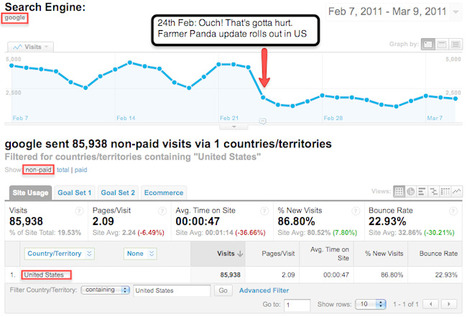
As of 24th Feb 2011, a major update by Google on how it ranks sites has affected 12% of search results and halved many sites’ visitor numbers. Named the Farmer or Panda Update it’s only affecting US Google results as I write but if you’re outside the US it is coming to you soon. Here’s how to find out if you have already been hit, are going to be and what to do about it.
Can your business handle a 50% drop in organic (non-paid) visits from Google? That’s what might be coming your way courtesy of Google’s Panda algorithm update. Before we get into the whys and wherefores, find out if you’ve been hit by Panda
A Google patent application filed on the same day as the first Panda update describes how Google might incorporate user information such as visitor frequency and number of visitors into how they rank pages.
Google recorded a record $9 billion in revenue last quarter, pleasing Wall Street, which had been jittery on the search and advertising giant after it didn’t meet their expectations for the first part of the year.
But as Silicon Valley Watcher’s Tom Foremski pointed out, there’s an oddness in Google’s results.
The growth in revenue for sites that run Google ads (the AdSense program) increased 20% from the second quarter results in 2010 and 2% since last quarter. Usually the revenue from those ads grow at about the same rate as the revenue from ads Google gets from its own properties, such as its search engine.
But revenue from ads on Google’s own sites jumped 39% since the same quarter 2010 and 6% since last quarter.
That’s odd, Foremski says.
This huge disparity between the growth rates of Google sites and partner sites is without precedent for most of its history. For example, in 2010, Google sites never exceeded the growth rate of partner sites:
Ever since the introduction of the Panda Update, affected publishers have been scrambling to recover rankings and search traffic.
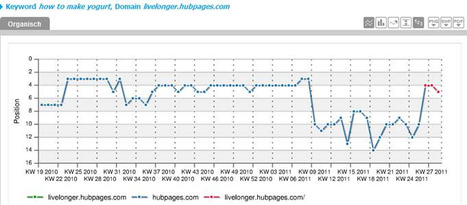
One of the most outspoken publishers is the content farm hubpages.com, which lost 80% of its visibility in Google US search results in the initial rollout of Panda. Their CEO dealt with the situation aggressively, publically stating his efforts for improvement and trying to get in touch with Google employees.
According to the WSJ , this was met with success in Mid-July – the paper claims that “In June, a top Google search engineer, Matt Cutts, wrote to Edmondson that he might want to try subdomains, among other things.”
To most SEOs, this comes as a surprise. For years, adding folders to an established domain tended to perform much better for most people than adding subdomains – an opinion that was perpetuated by Matt Cutts himself, as Aaron Wall explains in great detail.
Enter Panda. Rather than being a change to the overall ranking algorithm, Panda is more a new ranking factor that has been added into the algorithm (indeed, on our SEO Periodic Table, this would be element Vt, for Violation: Thin Content).
Panda is a filter that Google has designed to spot what it believes are low-quality pages. Have too many low-quality pages, and Panda effectively flags your entire site.
Being Pandified, Pandification — whatever clever name you want to call it — doesn’t mean that your entire site is out of Google.
But it does mean that pages within your site carry a penalty designed to help ensure only the better ones make it into Google’s top results.
Google's Panda update was designed to eliminate spam and content farm content, thus improving the quality of Google's index and SERPs.
Many sites caught in Panda's grip claim that they were unintended victims of the update, and have sought ways to recover.
Many have been unsuccessful in reestablishing themselves with Google, but according to the Wall Street Journal, one publisher may have found the secret to recovery.
That secret: break up a site zapped by Panda into lots of smaller sites. HubPages, one of the 'content farms' hurt most by Panda, reportedly lost some 50% of its traffic following the update.
But by reorganizing its content into subdomain-based sites, a tip the Wall Street Journal says was provided directly to HubPages by Google's Matt Cutts, the company is seeing "early evidence" that such a move can bear fruit:
Many sites are still wondering how they can come back from being hit by the Google Panda update. Google has certainly stressed quality, and victims of the update have been striving to improve it, but have had little luck in terms of boosting their rankings for the most part.
Have you been able to recover any search traffic after being hit by the Panda update? Let us know.
When we talked to Dani Horowitz of DaniWeb, she told us about some other things she was doing that seemed to be helping content rank better, but it was hardly a full recovery in search referrals.
It wasn’t too long ago that the Google Panda algorithmic update was announced (I blogged about Panda recently), and it is probably the biggest topic in the SEO industry right now. Mostly because a lot of people got mortally wounded by it. This is how it affected me, as far as I can see.
If you know about current SEO, you have heard about Panda/Farmer and Panda 2. But you're not out of the woods yet. Learn about the latest and most important/dangerous Panda update, Grey Panda 3, what it is and how to protect your site.
Google previously released an authorship markup that lets content creators claim the articles they've written. This markup is being taken a step further ...
Google has confirmed to Search Engine Land that late last week, it pushed out a small update to the Panda filter.
“We’re continuing to iterate on our Panda algorithm as part of our commitment to returning high-quality sites to Google users,” a Google spokesperson told us.
“This most recent update is one of the roughly 500 changes we make to our ranking algorithms each year,” Google added.
Over the past week or so, I have been tracking the complaints in the various forums, including the large ongoing thread at WebmasterWorld.
Among Internet marketers and SEO experts, Google’s Panda/farmer update is not a new thing anymore. It is a well-known fact that there have been a lot of new updates and changes within Google’s ranking algorithms via Panda/Farmer update.
The main reason for this is the growing number of content farms. Content is bought or copied from free sources and through different tactics people ranked their sites. It is not right to rank these pages highly in the search engines, so Google came up with the Panda Update.
Since Google in February began changing the way its search engine ranks sites in order to weed out “low-quality” content and “article vomit,” thousands of negatively affected website publishers have scrambled to recuperate. Now HubPages.com, one of the largest sites hit hard by Google’s new “Panda” ranking algorithm change, said it may have found a solution: divide itself into thousands of smaller sites.
The five-year-old HubPages, which publishes content from hundreds of thousands of authors and primarily relies on Google search to obtain Web traffic, has seen “early evidence” that its overhaul may be able to “lift the Google Panda death grip,” said Paul Edmondson, its chief executive, in an interview.
Google Panda Update – Are Sub Domains the Solution or just a Short Term Fix ?
One of the more interesting articles from the world of search this week was this carried by the Wall Street Journal covering how HubPages have loosened the Google Panda Death Grip.
In that article the HubPage CEO claims he saw improvement in the rank of his articles on HubPages once moved onto a sub domain. This was first brought to my attention by David Harry who runs the SEO Dojo and Reliable SEO:
The Wall Street Journal published an article July 13 all about HubPages, and how the site saved itself from Google Panda’s evil clutches by spreading their site across multiple subdomains.
In the article Amir Efrati implies in a very-hard-to-pin-down-but-easy-to-assume way that subdomains may be a magical solution if you’ve been nuked by the Panda update.
That pisses me off.
A lot.
But, before I rant about unqualified people writing on specialized topics, I’ll clear up the subdomains hysteria.
When Google rolled out the first Panda update on 23 February 2011, we saw our site traffic plummet by 40%. I learned about this four hours after quitting my day job to become a full-time blogger. I don’t regret the decision for a second, but it presented some unique challenges for the days ahead.
Since then, we’ve employed several different strategies to reclaim our former glory. Research and site analysis led us to remove potentially low quality content.
We’ve experimented with modifying and removing ads, all the while trying to better the user experience. It’s important to know that we haven’t seen a recovery … yet.
None of what I’m about to share has made a significant improvement, but hopefully this article will provide insight for other publishers.
Google has maintained that there were no exceptions to Panda & they couldn't provide personalized advice on it, but it turns out that if you can publicly position their "algorithm" as an abuse of power by a monopoly you will soon find 1:1 support coming to you.
The WSJ's Amir Efrati recently wrote: In June, a top Google search engineer, Matt Cutts, wrote to Edmondson that he might want to try subdomains, among other things.
We know what will happen from that first bit of advice, in terms of new subdomains: billions trillions served.
Vanessa Fox, called a cyberspace visionary by Seattle Business Monthly, is an expert in understanding customer acquisition from organic search.
She shares her perspective on how this impacts marketing and user experience and how all business silos (including developers and marketers) can work together towards greater search visibility at ninebyblue.com.
She’s also an entrepreneur-in-residence with Ignition Partners, Contributing Editor at Search Engine Land, and host of the weekly podcast Office Hours. She previously created Google’s Webmaster Central, which provides both tools and community to help website owners improve their sites to gain more customers from search and was instrumental in the sitemaps.org alliance of Google, Yahoo!, and Microsoft Live Search.
She was named one of Seattle’s 2008 top 25 innovators and entrepreneurs. Her book, Marketing in the Age of Google, provides a blueprint for incorporating search into organizations of all levels.
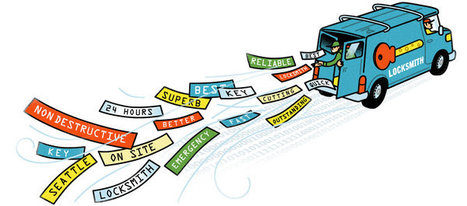
BOB STROM is the owner of Ballard Lock & Key, which provides locksmith services in Seattle. If you live in the area and find yourself locked out of your car or home, here is an essential piece of information about Mr. Strom’s company: it really exists.
By that, the Haggler means that there actually is a guy named Bob Strom, who is a bonded locksmith. And he owns a business, which you can visit, at 7352 15th Ave NW. This might seem too obvious to note, but it sets Mr. Strom apart from more than 90 percent of his local competitors. According to Yelp, there are — no joke — nearly 3,000 locksmiths in Seattle, though with relatively rare exceptions these operations aren’t in Seattle at all.
They are phone banks, typically set up in far-off places, often in other countries. Call them and they’ll dispatch a locksmith. Some are legitimate, but others may all too often do shoddy work and/or charge two or three times the estimate.
In the last five years, some of these lead generation companies, as they are known, have become notorious. A few have been sued by state attorneys general. Several have shown up in gotcha television news stories, a selection of which can be viewed on YouTube by searching for “locksmith scam.”
You might assume that lead gen sites would be no competition for people like Bob Strom. But for a couple of years, in one crucial arena, they have been crushing him: Google search results.
Jonathan Allen, Director, SearchEngineWatch, interviews Thom Craver, Web and Database Specialist, Saunders College (RIT), Dave Davies, CEO, Beanstalk SEO, Ga...
To get content containing either thought or leadership enter:
To get content containing both thought and leadership enter:
To get content containing the expression thought leadership enter:
You can enter several keywords and you can refine them whenever you want. Our suggestion engine uses more signals but entering a few keywords here will rapidly give you great content to curate.


 Your new post is loading...