It’s here. It’s inevitable. It’s called Google Panda, the latest Google’s search algorithm which aims to promote the high quality content site by dooming the rank of low quality content sites.
Since its release and updates, many sites have been shown to be terribly affected by the algorithm, but the worst rumor here is, they can do almost nothing to recover the ranking and traffic.
Although the web haven’t sought out an absolute remedy to the Panda’s update, we all know that Panda is pretty much a content quality filter.
We also know a proverb saying, “Prevention is better than cure”, so in this post we are going to provide 5 essential tips to help you to prevent the judgment by Google Panda. Full detail at the jump!
Signed in Google users around the world can now help Google figure out which sites aren’t helpful or useful. When users block a site, Google now incorporates this data into the periodic Panda updates to better highlight “high quality” content.
Google announced that on “most” Google domains, you should now see a note underneath or next to the URL (“Block all example.com results”) when you click the back button and return to Google’s search results.
For example, if you stumble across a lousy website that borrows your content, such as www.falconeconsultdesign.com, now you can hit the back button and ban them from ever showing up in your results again (that headline sure seems familiar…).
After a poof, the results are gone, and Google tells you they won’t show you results from that domain again. If you blocked the wrong result, you can quickly undo it by clicking the Undo link.
Jonny Stewart is Head of Search & Social Media at The Review Centre, and has been working in search for over seven years.
He spoke first at BrightonSEO, with a presentation all about the Google Panda update, something which his followers on twitter will know is close to his heart.
The Google Panda update is an update which was made to Google’s algorithm this year, in order to provide users with better search results. The aim of the move was to reduce the number of low quality content sites being shown in the search results.
Google Panda effected a great number of websites, but some sites suffered worse than others, and digital marketers have been trying to understand the change ever since.
This presentation presented data and insights from The Review Centre website, which was severely impacted by the Panda update, and the efforts and activities which were undertaken in order to overcome it.
Google has maintained that there were no exceptions to Panda & they couldn’t provide personalized advice on it, but it turns out that if you can publicly position their “algorithm” as an abuse of power by a monopoly you will soon find 1:1 support coming to you.
The WSJ’s Amir Efrati recently wrote: In June, a top Google search engineer, Matt Cutts, wrote to Edmondson that he might want to try subdomains, among other things.
What are the “among other things”?
We have no idea.
All we know is that it has been close to a half-year since Panda has been implemented, and in spite of massive capital investments virtually nobody has recovered.
Recall that a few years back Google stated they were treating subdomains more like folders on a main website. Except, apparently that only applies to some parts of “the algorithm” and not others.
I met with Paul Edmondson, CEO of HubPages, and Jason Menayan Director of Marketing to talk about how the publishing site is dealing with the aftermath of Google’s major update to its algorithm, Panda, released earlier this year.
Panda has caused huge problems for publishers because it cut off massive amounts of traffic in a bid to force publishers to produce higher quality content.
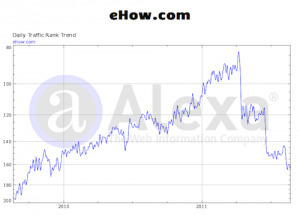
There have been four versions of Panda released since late February. Each new version of Panda has impacted traffic to large content sites. You can see the damage here:
The six month anniversary of Google’s Panda update passed quietly yesterday – guess everyone was too distracted dealing with the latest tweak to the algorithm to notice.
The only article I saw was by ZDnet reporting that HubPages CEO Paul Edmondson says SEO doesn’t work (seriously guys, three exclamation in the headline?).
Panda has created a scenario where publishers who don’t embrace SEO are condemned to feel the sting of what happens when they don’t. SEO DOES WORK but you can’t rely on your father’s methods anymore.
Over the past week or so, Searchmetrics has been sharing info on the winners and losers of Google’s Panda update in Europe. Today, they shared their data for Switzerland, Italy and Spain.
Searchmetrics has also shared data on Austria, France and Germany.
On August 12, Google announced that it was beginning to roll out Panda in all languages around the world, except for Chinese, Japanese and Korean.
Google’s Amit Singal said Google was still testing improvements in those languages.
“For most languages, this change impacts typically 6-9% of queries to a degree that a user might notice,” said Singhal. “This is distinctly lower than the initial launch of Panda, which affected almost 12% of English queries to a noticeable amount.”
A WebmasterWorld thread has SEOs and webmasters discussing the fact that some of them have removed 75% or more of their content from their web site or is planning to based on all the changes with the Google algorithm related to the Panda algorithm.
Now that Panda has rolled out bilingually, it is now affecting more and more webmasters.
Webmasters are seeking advice from those who have "recovered" over the past couple months and most of those said they have deleted or blocked the content that seemed less useful to their users.
Google's Panda update has now launched around the world in all but three languages.
Here’s a look at some new statistics showing which websites in Germany, France, and Austria were hit and rewarded as a result of the expanded Panda rollout.
Panda, first released in the U.S. in February of this year, has seen plenty of iterations since, with manual updates hitting almost monthly.
However, more important to Google's grand scheme, Panda has slowly been trickling across borders. In April, Panda also made its way to the UK. Now it's made a great leap forward internationally.
Maybe the reason why you can’t even quite get into the top-five or number-one spot on Google search is because you’re not spending enough time or money getting the best Web host and Web server you can afford and then optimizing how your serve your Web pages, especially when your modern CMS is backed by a database.
I have a theory that both where you end up on search results as well as how much money you can make advertising AdWords ads via AdSense depends not merely on SEO or surfing the right trends or even finding the long tail sweet spot, but also on how quick, responsive, reliable, and durable the server that hosts your blog or site is. The faster the page loads, the better your site will rank on Google search, all other things being equal.
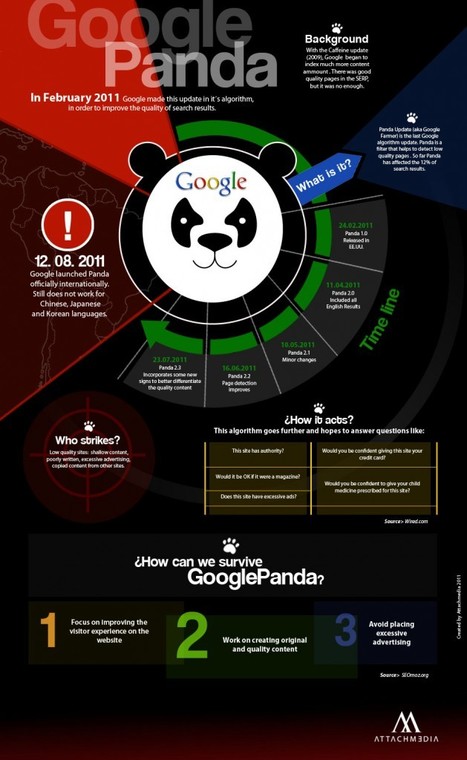
I was recently contacted by Carlos Paulinich, who created this amazing infographic that shows a graphical representation of the Google Panda Update. I thought...
There are some rumors shuffling around the SEO industry that there is a new Google Panda update taking place right now.
Update: Google said there is no update taking place right now.
Tedster started a thread at WebmasterWorld asking,
“I’m hearing some reports of site-wide ranking demotions over the weekend that have a similar pattern to what we saw with Panda.
That is, lots of keywords affected, but the demotions are not at all uniform the way we often see in a site-wide penalty.”
One full time member confirmed some major changes, saying:
"Sustained dip on sites with a local relevance, beginning on the 17th, maintained through today.
Sustained 40-50% increase on niche-info type sites, started on the 13th, maintained through today. (on sites I watch, this generic site action/reaction is typical within 4-10 days after a large googlebot crawl)"
Large publishers who lobbied Google hard for a ranking boost got it when Panda launched: “A private understanding was reached between the OPA and Google,” an office assistant with e-mail evidence told Politically Illustrated.
“The organization is responsible for coordinating legal and legislative matters that impact our members, and one of the issues was applying pressure to Google to get them to adjust their search algorithm to favor our members.”
At the same time, said "premium publishers" were backfilling their websites padding them out with auto-generated junk created by companies like Daylife, where some of the pages offer Mahalo-inspired 100% recycled content.
With the early August release of the Panda algorithm update on a global scale we saw substantial changes in several European markets. We've previous...
Google is calling for help in identifying a long-running problem: scraper sites in its search results — and particularly scraper sites that are ranking higher than the original page.
Matt Cutts, the head of Google’s spam fighting group, put out the call for help on Twitter this morning: Scrapers getting you down? Tell us about blog scrapers you see: http://goo.gl/S2hIh We need datapoints for testing.
The link leads to a Google Doc form that asks for the exact query where there’s a “scraping problem,” along with the exact URLs of the original and scraper pages. The form explains that Google “may use data you submit to test and improve our algorithms.”
It’s not entirely unusual for Google to call for help like this, but it’s noteworthy because the issue of scraper sites has been particularly prominent in recent months.
I’ve been writing about Google’s Panda algorithm change and the huge amount of pain that it’s caused for content websites since it was introduced in late February.
Before the launch of Panda Google spent months bad-mouthing “content farms” and how the new algorithm would weed out the bad content. The first version was called “Farmer” as a reference to “content farms” — sites that scrape or produce low quality content just to game search rankings.
Who could argue with such a noble goal?
Yet when the Panda “Farmer” algorithm hit the Internet, it failed to highlight “quality” content.
Quality sites, such as my friends at Ubergizmo, lost rank and their scrapers ranked higher than them.
On August 12, Google announced that their high-quality sites algorithm, otherwise known as "Panda", had been rolled out for all languages save for Korean, Chinese, and Japanese.
The change is said to impact 6-9% of users' queries, down from the 12% seen in the initial Panda update back in February.
Though the official announcement post doesn't make mention of this update's effect on English queries, Vanessa Fox at Search Engine Land reported that a few minor changes were made, but there shouldn't be a substantial impact.
Only 9 hours earlier, the Google Analytics blog announced a change to the way visits are to be calculated, effective immediately. We'll get into just how this changed in a bit, but according to the announcement post, "most users will see less than a 1% change".
So, with all of of my clients being US based, I wasn't expecting to see much of a change from Panda, and I can deal with a 1% change in Google Analytics.
However, apparantly two insubstantial impacts make a big one, because upon checking Analytics on Monday night, I was surprised to see this:
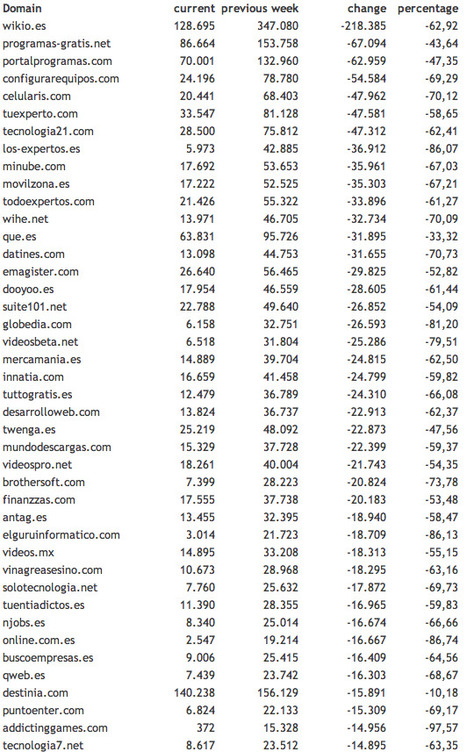
In Italy and Spain too, low-quality content has not been spared by Google’s Panda update.
After already announcing the winners and losers in the USA, UK, Germany, France and Austria, the lists for two other major European countries are now available.
Just as before, on the basis of absolute and percentage values we are demonstrating which domains in these countries have achieved gains and losses in terms of their visibility in the Google search results.
This is therefore not the same thing as a rise or drop in traffic as I explained in this blog post.
"Note: This is a follow-up to my earlier post on Curation in the Enterprise, and seeks to develop some of the themes introduced there.] F...
s can filter. Only humans can curate.When a human curates, she does three things. She selects something (or things) from a larger group. She organises those selections cohesively. And she arranges to present those things in such a way that people find it easy to engage with those things.
What I thought I’d do in this post is to look at all this a little more closely, all in the context of the social enterprise.
First, let’s look at selection.
The simplest and commonest form of selection in social networks is the asymmetric follow (a phrase I first heard used by James Governor). You follow someone or something, you subscribe to that someone or something. Elect to receive updates, alerts, reports. That doesn’t mean they follow you.
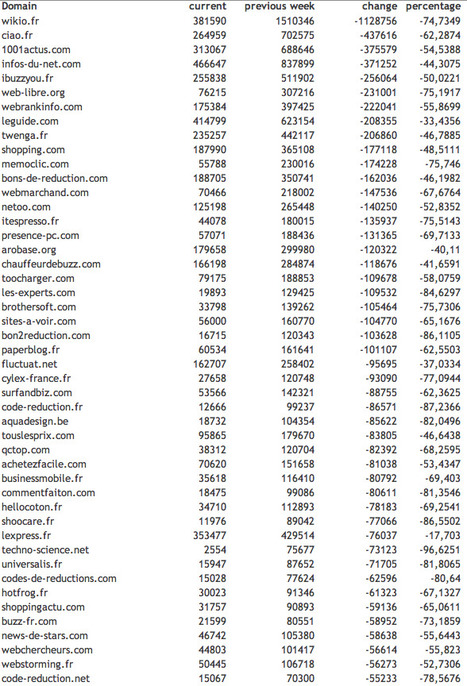
Having considered the German winners and losers, here is an analysis of which French sites have incurred visibility gains and losses from Google’s Panda Update.
In France, the update seems to have affected a similar group as in Germany, the USA and England, but there are still a few surprises you might not have expected.
There are a number of winners in France that were counted among the losers in Germany. If there was any doubt before, this makes it clear that this is an algorithmic update and not a deliberate manual devaluation of entire sectors.
To get content containing either thought or leadership enter:
To get content containing both thought and leadership enter:
To get content containing the expression thought leadership enter:
You can enter several keywords and you can refine them whenever you want. Our suggestion engine uses more signals but entering a few keywords here will rapidly give you great content to curate.


 Your new post is loading...