Your new post is loading...

|
Scooped by
Robin Good
May 2, 2011 1:47 AM
|
People love to talk about the ways that search engines determine their rankings. I always advise our clients to stay away from trying to find "the edge of the algorithm" or any practices that are manipulative because of the risk these tactics carry, but the search engines continue to have many limitations on what they can do, and how they interpret what they see.
Therefore it is prudent for publishers to understand the landscape, and do the right things to make the job of the search engines easier. The SEOmoz ranking factors survey includes a great pie chart showing an estimation of the weighting of the various ranking factors:
|
|
Scooped by
Robin Good
April 30, 2011 3:05 AM
|
Interestingly enough, a Googler actually posted a guest post to the HubPages blog before the Panda update rolled out globally, providing tips for HubPages writers to put out better content for AdSense. Since the global roll out, HubPages announced changes like the removal of a “news capsule” feature, and tightening up its policy on affiliate links.
|
|
Scooped by
Robin Good
April 29, 2011 12:57 AM
|
During The New York Times Company's (NYSE:NYT) Q1 2011 earnings conference call, management discussed the negative impact that the recent algorithm changes in Google (NASDAQ:GOOG) have had on NYT.
|
|
Scooped by
Robin Good
April 28, 2011 1:30 AM
|
The impact of Google’s ‘Panda’ update might be restricted to a relatively small number of 'low quality' websites, according to the search community. I have received some new data that further supports this idea.
|
|
Scooped by
Robin Good
April 27, 2011 5:56 AM
|
Johannes Beus, manager of the SEO tool provider SISTRIX has, in today's blog post initial thoughts employed, which metrics as possible ranking signals of Google Panda updates for SEOs are should keep an eye on, when it comes to any vulnerable candidates of in this country pending algorithm updates the run to analyze already.
|
|
Scooped by
Robin Good
April 27, 2011 2:40 AM
|
In late March 2011, I gave a 15 minute talk at the iBreakfast Meeting in Manhattan. A few days earlier, I spoke at an Incisive conference in Hong Kong, delivering essentially the same message.
In a nutshell, I pointed out that Google’s algorithm changes were only the tip of the iceberg regarding relevance improvement in search results. Search engine optimization or SEO has gamed the free Web indexes so that relevance is decreasing.
The fix, I said, is to focus on content. My name for this approach is “content with intent.” The idea I told the two different groups is to create high value content and follow the basic rules of providing facts, sources, and useful information.
|
|
Scooped by
Robin Good
April 26, 2011 10:51 AM
|
The "Farmer" Update of February 23, 2011(AKA "Panda" Update, "Farm" Update) Much is being said about the Google "Content Farm" update. Opinions and counter opinions are rampant. Here are some theories and conclusions that have been advanced, by webmasters at Webmaster World.
|
|
Scooped by
Robin Good
April 26, 2011 2:26 AM
|
Experian Hitwise reports that downstream traffic to content farms has taken a big hit since Google's Panda initiative went into effect.
|
|
Scooped by
Robin Good
April 25, 2011 2:31 AM
|
While the Google panda update is still new, we do have some insight into the algorithm change. In this post we will focus on how the Google panda update has affected websites.
We will also make a few recommendations on how to alter your SEO to improve post panda update rankings.
There have been many posts focusing on what the Panda update is hurting; in this post we will focus on what the Panda algorithm update likes.
|
|
Scooped by
Robin Good
April 23, 2011 6:02 AM
|
HubPages, one of the big victims of Google's Panda update announced that it is making some changes aimed at getting back in Google's good graces to bring its...
|
|
Scooped by
Robin Good
April 23, 2011 4:02 AM
|
London: A number of prominent UK technology news sites have seen their Google rankings drop substantially after the search engine rolled out its "Panda" update, intended to demote sites which scrape content from others, to the UK and other English-language Google users.
|
|
Scooped by
Robin Good
April 22, 2011 5:50 AM
|
Where you affected by the Panda update, Andrew Wise of LinkWheelers offers his insight into how to survive in a post panda world...
|
|
Scooped by
Robin Good
April 22, 2011 2:24 AM
|
Run for your lives it's another post about the panda update!
|
|
|
Scooped by
Robin Good
May 1, 2011 1:50 AM
|
As bloggers, we often refer to previous articles, and we have this habit of searching for an older post or checking on who is syndicating our content.
After the second Panda update, we could not find many of our own posts with a search on the title or a specific phrase from the article.
Instead, what we found was that sites that *steal* our content do rank higher in the Google search results, while our own post archive could not even be found. We immediately knew that something was very, very wrong.
If you have your own site, do this: copy the first line (or the title) of a post, and search for that phrase. If this phrase is unique enough, your article will appear first (if not, you will simply compete with others).
|
|
Scooped by
Robin Good
April 30, 2011 2:47 AM
|
Still, those numbers are bound to chill many a journalist. You think posting reader metrics in newsrooms is still a point of contention — wait ’til story cost accounting becomes mainstream. And it will.
|
|
Scooped by
Robin Good
April 28, 2011 1:40 AM
|
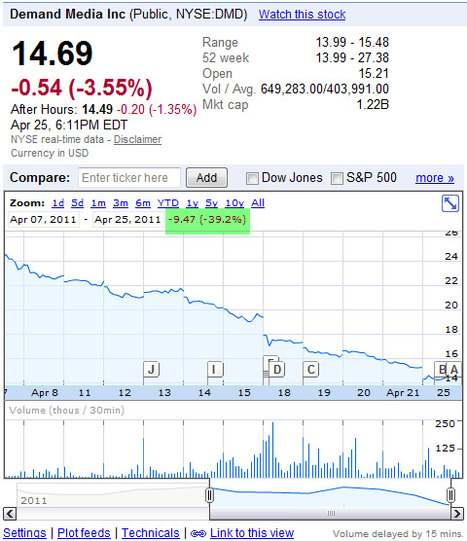
When Google began speaking publicly about content farms Demand Media's Richard Rosenblatt stated that it would be silly to call their stuff a content farm & he emphasized the quality of their content & care that went into it. Of course, those who bothered looking at the content often saw something different.
|
|
Scooped by
Robin Good
April 28, 2011 1:29 AM
|
Back in December I wrote an article on how site scrapers were gaming Google's (GOOG) search algorithm in order to make advertising money from articles that they scrape from RSS feeds.
Just after I wrote this piece, Google got religion about spam sites and revamped its search engine results to penalize content farms. Yet, the problem with scrapers still remains.
|
|
Scooped by
Robin Good
April 27, 2011 5:55 AM
|
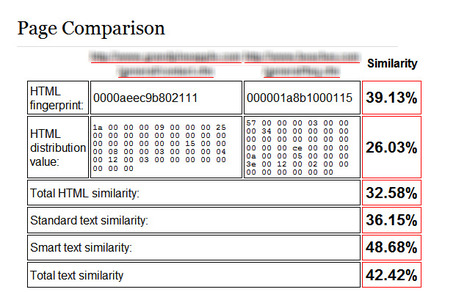
How To: The SEO Tools and Process to Address Duplicate Content
An SEO services client with which we work has developed multiple websites for different brands, but the client recycled the content.
Instead of writing 100% unique text for each website, paragraphs and sometimes whole pages were used universally across multiple websites.
They were getting away without noticeable revenue loss, so despite existing duplicate content penalties on interior entry pages, the client decided it was not a big enough priority to rewrite all the content … until now
|
|
Scooped by
Robin Good
April 27, 2011 2:38 AM
|
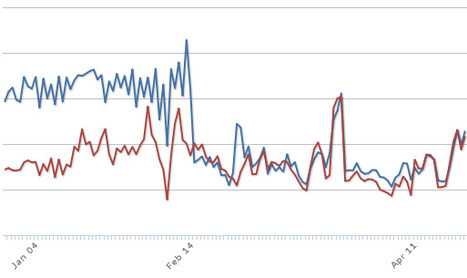
Here’s a graph that we’re sure most SEOs will find pretty interesting, especially those of you who work in the UK or with UK clients.
What you see below is our fluctuation charts for the last 120 days, with Google US (blue) plotted against Google UK (red).
Do you see any sudden correlation with the data in the last 2 months, and specifically since somewhere around April 11th?
|
|
Scooped by
Robin Good
April 26, 2011 9:06 AM
|
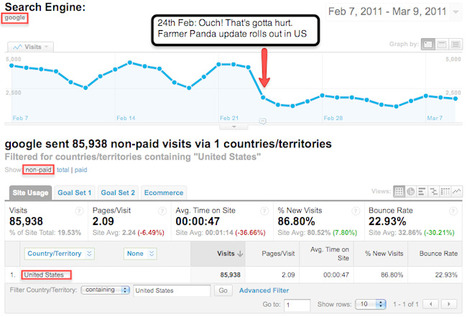
As of 24th Feb 2011, a major update by Google on how it ranks sites has affected 12% of search results and halved many sites’ visitor numbers.
|
|
Scooped by
Robin Good
April 25, 2011 8:19 AM
|
Google's Panda update represents more than just an algorithm change to weed out content farms; it represents (perhaps) a first step in a series of fundamental shifts that will enable Google to become more socially-focused.
|
|
Scooped by
Robin Good
April 24, 2011 5:20 AM
|
A handful of companies that I know were hurt by the algorithm change named Panda. Panda was focused and aimed at targeted content farms but has impacted many businesses.
One friend of mine had to layoff his first employee due to their loss in ranking on a professional directory service that led the rankings for about a decade. Today, we paused a relationship with one of our favorite clients. Their huge loss in advertising revenue had to be dealt with (we’ll still continue to support them since I have no doubt their traffic will return).
On the search engine optimization side, the talk was a bit tougher. When Google liked content farms, we pushed the infrastructure to publish content horizontally. A specific topic in their arsenal could have 22,000 pages under it – and we we pushed them all. The site was enormous, but leveraged Google appropriately – skyrocketing traffic and revenue.
|
|
Scooped by
Robin Good
April 23, 2011 6:01 AM
|
One thing is clear, there are two Pandas in Google’s doodle for Earth Day today. Whether that is an intentional reference to the recent Panda algorithm update is debatable. There are two of them, and there have been two roll-outs of the Panda update – one in the U.S. and then one globally (in English).
Of course there are other animals that appear in the doodle – a lion, a couple of penguins, a koala bear, a brown bear, a frog, a red bird, and a fish (which gets eaten by the bear).
|
|
Scooped by
Robin Good
April 22, 2011 5:52 AM
|
Google has in many ways the best of intentions and often does right by its users. I value their leadership in so many respects.
|
|
Scooped by
Robin Good
April 22, 2011 5:47 AM
|
Burned by Google's recent changes to its search formula, small businesses are experimenting with strategies to recover lost Web traffic while seeking out new ways to generate sales.
|