From the article: "A tweak in the way Google ranks websites has had serious consequences for many web-based businesses and has led to accusations of anticompetitive practices.
...Any day now, the European commission is expected to announce whether it will formally object to what some see as Google's abuse of its power in the way that it treats smaller sites that offer the same sorts of services as it does.
If that happens, Google could be forced to comply with strictures on the way it treats rival sites offering particular sorts of search – for news, products, maps, shopping, images or videos – rather than pushing its own on the site.
Alternatively, it could face fines of millions of pounds.
The EC began its investigation almost a year ago, after complaints from a number of companies, including Foundem.com, a British "vertical search engine" company that offers comparisons for a huge range of products and services, such as flights, hotels, gadgets and jobs.
Foundem says that it was repeatedly demoted in Google's search rankings despite breaking none of its publicly-stated rules. Shivaun and Adam Raff, its founders, woke up in 2006 to discover they had suffered the same fate as Lee: their site had vanished."
In a world where “content is king,” you might think that those who publish thousands of articles every day would rule inbound marketing and reign over the modern, online world equivalent of the Roman Empire.
And, like Caesar before them, for a time, they did.
That is, until Google unleashed, of all things, a panda, and collapsed their empires the way Odoacer deposed Romulus Augustus and squashed the Roman Empire for good in 476 A.D.
Let's take a quick look at how Google's Panda algorithm update changed SEO and what you can do as a marketer to stay on Google's good side.
Step 1. Post content that is of little to no value, off-topic, or boring.
Step 2. Post content too infrequently.
Step 3. Post content with too few keywords or the wrong keywords.
"Matt Cutts has repeatedly said that quality content is key to Google rankings, and Bing’s Duane Forrester reminded marketers that “all SEO ranking signals revolve around content of some kind” at SMX Advanced 2011.
High-quality, search-friendly content allows businesses to populate their sites with keywords and valuable information for visitors (and both are important to search success).
Brafton’s infographic, Why Content For SEO, explores how content is key to search engine visibility."
From the article intro: "The cute, cuddly Panda bear has struck again. In the midst of Google’s latest algorithm change, many marketers are in a tizzy over how their search engine presence — and ranking — will be impacted.
The SEO game keeps changing, and as a content marketer it’s important to understand what the changes are and how to use them to stay competitive.
The latest change is actually designed to reward, not punish content writers (or at least the ones who are doing their jobs well).
In a recent press release, Google states, “Search results, like warm cookies right out of the oven… are best when they’re fresh.”
This time around, the algorithm change is designed to place relevance on the quantity of new content a site contains (remember, the focus of the Panda update earlier this year penalized low-quality content, and content farms).
It’s been projected that these latest changes will impact 35 percent of all search queries.
For marketers who are constantly updating their blog, social media sites or website content, this is great news.
For those marketers who know they should have consistent content but have been unable to produce enough, this change may seem daunting.
To help alleviate some concerns you may have, here are some ideas on how to meet the quality and quantity requirements Google has made mandatory for online marketers:"
Amit Agarwal of Digital Inspiration reports: "When you publish an article on your blog, the RSS feed is updated and everyone subscribed to that feed will instantly know that there’s something new worth checking out on your blog.
A majority of your blog feed subscribers will be human beings who are genuinely interested in reading your articles but some bots may also be watching your feed and their only intention is to scrap web content and republish it on to their own website.
These content scraping bots can sometimes confuse search engines. You write a story on your website and, because of these bots, a dozen sites manage to copy that story word-by-word often within seconds of you hitting the publish button.
You can add links in the feed to say that you are the original author but scrapers can easily remove them with a simple preg_replace.
What next?
Google engineer Matt Cutts, during his keynote at PubCon 2011, suggested that website owners set up fat pings which essentially means that you inform Google about new content as soon as you publish it on the web.
And since it’s a fat ping, you just don’t inform Google but also send them the entire content of your blog post."
"Human beings will create 1.8 zettabytes of data in 2011. Search can longer keep up.
Web search remains the heart of the Internet. It’s our near-universal homepage. But, increasingly, it fails to deliver results that were as useful as they once were, for two reasons:
The shear volume of web data continues to rise at a brutally quick pace.
SEO is being used to manipulate search results with subpar content to turn a quick buck.
Google has been flailing throughout 2011 to try to fix the second issue (see Panda fiasco).
As for the data volume issue, Bing director Stefan Weitz insists that there’s one big answer for solving it: tapping social.
“The infusion of the social signals into search is the next generation of search,” said Weitz.
That won’t surprise anyone. In fact, Google finally recognized this in 2011 with the launch of Google+ and its tight integration into Google search.
However, while Google views social as a layer that adds value on top of its search, Weitz and Bing view it as an central element of the future of search.
And, what most people don’t realize is that Bing already has more and better social data than Google because of Bing’s strategic partnerships with Facebook and Twitter."
from the article: "At PubCon in Las Vegas, Google’s Matt Cutts and Amit Singhal held a webmaster Q&A session with attendees, and referenced (among many other things) some algorithm testing that they’re doing, which we may see the results of in 2012.
This involves Google’s algorithm examining what appears “above the fold” on a content page, and more specifically, what appears in the way of ads.
What is acceptable to have above content on a page?
There hasn’t actually been an update roll-out of this nature to my knowledge, so the effects would not necessarily have been felt by “infringing” sites yet, but from the sound of it, it’s coming.
As far as what actually happens in terms of fallout, we’ll cross that bridge when we come to it, but this is still something site owners and webmasters should be thinking about and possibly preparing for."
Cyrus Shepard authors a very useful and informative article on what can and should be done to avoid further pain and revenue losses for web sites that have been hit by Google Panda and which utilize AdSense ads.
From the article: "SEOs don't talk about advertising much, perhaps because it's the conceptual opposite of “great content.”
The truth is, advertising is the gasoline that runs much of the web.
Without ad revenue, great sites we love like Search Engine Land, Smashing Magazine, and even Wired might cease to exist.
Ads are great, but as SEOs we need to present them as the commercials that they are, not the main show.
Not long ago, it was common to see sites like this dominating the SERPs.
When Panda struck, sites like this got hit hard, time and time again.
Even websites with superior content were penalized if they contained over-aggressive ads above the fold.
I don't know if the site above was penalized by Panda, but I'm guessing their traffic is not as healthy as it could be, and a simple layout change would help significantly."
"Google is like an oil company which not only dictates the price of oil but also chooses where an oil field will exist."
Fantastic article by Andrew Johnson at SEOBook highlithing what he thinks are the reasons why we see so much discrepancy in the way Google treats different sites and partners.
Excerpted from the article:
"...first, I monetize my existing sites with Google's own products as much as possible.
Second: I no longer invest my time or money in new businesses that require Google's traffic.
Google [is likely to direct itself more toward] walled content gardens in its future. ...
As a consumer I want Google to have the best, most trustworthy experience possible. They can fight SEOs and affiliates all day long and it doesn't bother me.
I fully expected the innovative waves that helped the web destroy old media do the same again to itself.
But, when Google lies, and does things that in fact damage that consumers experience no longer can I defend Google (when eHow first started popping up in 50% of the searches I did I was shocked; I am absolutely appalled they still show up on page 1 for anything, the articles are obviously written by authors that re-hashed another article in 10 minutes and often factually incorrect on top of it.)
Greg Jarboe at ReelSEO has posted some interesting data and thoughts relating to the lastest Google update and how it may or may not influence traffic coming from YouTube.
From the article intro:
"According to Searchmetrics, YouTube.com was the biggest winner of the recent Google Panda Update, dubbed Panda 2.5. Supposedly, this means the “SEO visibility of the domain” improved 10% on Sept. 28, 2011.
But, before you do anything, you might want to take a look at the Discovery feature in YouTube Insight, which helps you understand how people discovered your videos.
When I looked at one client’s data over the weekend, I found that views from Google search had dropped from an average of 419 in September to 308 in October.
So, if a rising tide lifts all boats, then why is my dinghy sinking?
According to Searchmetrics, “Google thought that Panda 2.5 was a bit too much,” and rolled back large portions of the update a week later. Oh, and then “Panda Flux” continued for another week.
Then, on Nov. 3, 2011, Google rolled out a “freshness update” that impacted 35% of queries. And according to Searchmetrics, the SEO visibility of YouTube.com jumped 27%.
But, when I looked the Discovery feature in YouTube Insight, I saw a drop in views from Google Search from Nov. 2 to Nov. 3. On the other hand, views from Google search did bounce back up on Nov. 4. However, I haven’t uploaded a new video to that channel since Sept. 20.
In other words, trying to declare the winners and losers of Google updates based on week to week data on SEO visibility is as bogus as trying to predict next year’s top news stories based on last week’s top news stories."
Very interesting article indeed for those who want to understand better how the Google Panda Algorithm may work.
"Search engines use machine learning for pattern detection.
While it’s impossible to explain in one short article how machine learning influences our lives, understanding the basics of machine learning can give you some insight into search algorithm updates, such as Google’s Panda update."
"...the previous forecast shows a likely correlation between duplicate content and a bad user experience. But is it a causal issue or do sites with a lot of duplicate content also often have old-fashioned web designs, a bad brand reputation, or excessive advertising? And where do you draw the line between good and bad?"
Aaron Wall: initially when Panda hit...it seemed to hit larger sites with higher page counts. There are some exceptions to that, where some larger sites with either brand or some great user experience metrics slid through (and then as Google got more confident with the Panda algorithm they eventually applied it to some smaller sites as well).
What it boils down to, is Google is looking out for Google.
"With the recent Google Panda update in October 2011, we witnessed a huge uproar among webmasters and website owners as a lot of sites with high PageRanks fell like a heap of brick, while some others which had authentic organic links and well optimized pages climbed a few places more, unexpectedly.
...As the webmasters didn’t know of a recourse to sort things out and stabilize the fall, they were meddling in the dark on a course unknown till Google issued its new set of indices to rate and review websites, which made it pretty clear that unless websites were structured and built according to the new guidelines, there was no scope for improvement.
The upshot of the Google Panda algorithmic update was aimed at removing poor quality sites from the top of Google’s search results, while increasing the PageRank of sites that were structured optimally and had real organic value with better back links and original content.
Google’s new strategy is totally user-oriented, aimed at increasing user loyalty and user experience by improving the quality of search engine results at the same time bringing down BlackHat reliant SEO sites that had till then being exploiting Google’s vulnerabilities.
The Panda update is focused on deterring websites that rank high on search engine results through link farming and other BlackHat approaches rather than serving end users through long term organic SEO strategies."
"Google last week tweeted another of their algorithm Weather Reports.
While it's supposed to only affect less than 1 percent of searches, the results could be more impactful than that small number suggests.
Given 11.9 billion searches were conducted on Google last month, that 1 percent could represent an impact on millions of searches and thousands of sites.
Google's Weather Report may not have announced a major algorithmic shift, but it it isn't something we should overlook.
... this Weather Report could be the warning of a greater storm to come.
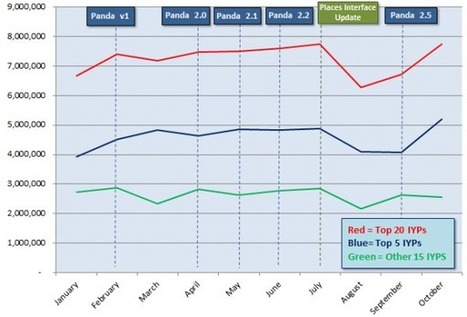
From the article intro: "2011 has been a dramatic year for the local SEO industry. Our little world is growing faster than ever with more businesses, more SEOs and more money flowing into the market. But it has also had its share of drama too.
Google has kept us on our toes with some fundamental changes to its Places algorithm, integration of local results and a major update to its Places interface.
There have also been considerable waves from Google Panda with 12% of search results being affected by this new algorithm.
By and large, local business websites have escaped the effects of Panda, but they were not the intended targets of this algorithm update.
However, the local directory/IYP market is a sector that has been affected by both the changes to Google Places interface and by Panda. I’m a big fan of IYPs and the marketing opportunities (both free and paid) they offer to local businesses.
The following charts look at the impact of Google’s changes on the IYP market and determine who are the big winners & losers in 2011 (so far!)"
From the article intro: "We all learned a lot after this year's Google Panda updates. Some site owners felt vindicated by finally seeing their efforts at legitimate SEO paying off.
Others were punished severely in the SERPs for grey and black hat tactics. While some of the vanquished were marketing professionals deeply entrenched in the ins and outs of SEO, unfortunately, many of them were people who turned their site over to an agency for management, or people who just plain didn't know any better.
So what's the glass half full perspective on all of this?
Well, Google Panda is kind of forcing site owners and managers to be, well, good marketers.
With the help of SEOMoz's algorithm timeline and Kuno Creative's fantastic cartoons, let's look back at the year's Google Panda updates and see how we can leverage them to be better marketers."
From the article intro: "Ok, maybe we’re starting to get a bit melodramatic about this whole Panda thing.
While it’s true that Panda didn’t change everything about SEO, I think it has been a wake-up call about SEO issues we’ve been ignoring for too long.
One of those issues is duplicate content. While duplicate content as an SEO problem has been around for years, the way Google handles it has evolved dramatically and seems to only get more complicated with every update.
Panda has upped the ante even more.
So, I thought it was a good time to cover the topic of duplicate content, as it stands in 2011, in depth.
This is designed to be a comprehensive resource – a complete discussion of what duplicate content is, how it happens, how to diagnose it, and how to fix it.
Maybe we’ll even round up a few rogue pandas along the way."
Adam Heitzman brings together what has been identified has being the key remedy actions to take if your web site has been hit by the Google Panda.
"For those of you who are unaware, the Google Panda update reportedly affected the rankings of almost 12% of all search results — more than any other update before.
Since then, Google has rolled out several other updates to Panda, dramatically changing how thousands of websites are ranked.
Those that were considered to be high-quality sites saw their rankings improve, while those of supposed low-quality essentially vanished from ranking at the top.
So now, the obvious question is this: How can we make websites that are seen as high-quality in the eyes of Google Panda?"
From the article intro: "Ever encountered an ad-heavy page, where you struggle to find the actual content on that page?
Google’s looking at penalizing those in its search results.
The head of Google’s web spam team, Matt Cutts, shared the news when speaking at the Pubcon conference today.
Cutts said Google is testing algorithms that determine ”what are the things that really matter, how much content is above the fold.”
Adding further, Cutts warned:
“If you have ads obscuring your content, you might want to think about it,” asking publishers to consider, “Do they see content or something else that’s distracting or annoying?”
"Under the new Google Freshness update, content that is updated much more frequently will be rewarded under the algorithm.
However, some opponents of the system have raised some doubts about what this will actually mean for search results.
For instance, the Google Panda update stopped many black hat techniques in their tracks such as keyword stuffing and directory listing with spam directories.
There was also some backlash with Panda, with many users saying that this particular update unfairly punished how to and wiki sites. However, the positive effect of Panda on search results and search engine optimisation both far outweighed the negatives – this was pretty much universally agreed upon by consumers and producers of online content alike.
Opponents of Google Freshness see a much higher probability for backlash with no positive effect. For instance, opponents say, simply making a small change to a page can give it a “freshness” update that will unfairly boost it to the top of search engine rankings without taking into account its relevance or true popularity. This would actually lead to huge decreases in relevancy and the ability of spammers and content with less gravitas to have greater presence in search results.
Google counters these critiques by saying that it has already incorporated search ranking factors that are tried and true in with the Freshness algorithm to reward content that is both fresh and good. They say that simply changing a small aspect of the page does not make it automatically become “fresh,” as opponents of the update say that it will."
Gianluca Fiorelli, of I Love SEO calls the new Google "Fresh" update, “Caffeine 2.0″ and shares some very interesting thoughts about how this change was brought about by advertising needs.
Claiming that Google is driven by ad space, and needed to make changes to reflect this:
“Google is an substantially an editor (even it will never recognize it) that sells ad spaces, and Search is still its main product to sell toward the advertiser.
So Google needs to have the best product to continue selling ad space.
That product was ironically endangered by Caffeine.
With Panda Google tries to solve the content issue and with the Social Signals linked inextricably to the Authors and Publishers tries to solve the obsolescence of the Link Graph.”
From the article intro: "I had a thought earlier today, funnily enough whist interviewing copywriters, which led me to think: how important is the quality of writing as a ranking factor following the Panda update?
Obviously the Panda update has had a negative impact to websites which have low-quality content – but, from the other way around, how has this impacted high-quality content?
Forgetting completely about links for now and assuming all things are equal, does higher quality written content now have more of a positive impact to search rankings?
Well I thought I’d do a few tests with Google’s reading level search filter to compare the differences between how content ranks which is either basic, intermediate or advanced."
To get content containing either thought or leadership enter:
To get content containing both thought and leadership enter:
To get content containing the expression thought leadership enter:
You can enter several keywords and you can refine them whenever you want. Our suggestion engine uses more signals but entering a few keywords here will rapidly give you great content to curate.


 Your new post is loading...






![How Content Is Key for Search Engine Visibility [Infographic] | Google Penalty World | Scoop.it](https://img.scoop.it/YvY8INyQmWzekxiWAmc6TTl72eJkfbmt4t8yenImKBVvK0kTmF0xjctABnaLJIm9)




![Firsthand Video Recount of How Bad a Panda Slap Can Really Be | WebProNews [Video] | Google Penalty World | Scoop.it](https://img.scoop.it/-7CfUwER3VSgJ-ga05Xt2zl72eJkfbmt4t8yenImKBVvK0kTmF0xjctABnaLJIm9)